
As 2025 drew to a close, a new project began stirring with me. After I finished Dancing the Tightrope, I developed a 5-week introductory course to help people be better under pressure. Then it sat in my computer for several years. A few went through it, but I knew from the beginning that an introductory course barely scratched the surface. At the same time, I’ve been cleaning out my office, preparing for our move sometime in 2026. I found my notes from The Artist’s Way, a book that’s really a program I did in 1999. The work I did in those few months still shapes me in meaningful ways, 26 years later. We moved to Lake Lure because of that work.
One of the exercises in the book asked me to write my 20 favorite things to do, in order if possible. Then go back and write the last time you did it. Guess what was number 1? I was actually shocked when I found the notebook and it said “ride horses.” The last time had been many years before. If you are a regular reader of this blog, you aren’t surprised, because I’m now deeply involved with horses. But that only barely began in 2017, the year that I fell off a horse and began the journey I shared in Dancing the Tightrope. It took me EIGHTEEN years!
While we are talking about statistics, when I decided to get back on the horse, I kept a list with the name of the horse and where I rode him or her. The first ride after my accident was basically a pony ride, as I did not let Trevor Dare, the trainer, hand me the reins. The pressure was too great. This horse was a reining horse, trained to spin on a dime, gallop full speed and then stop instantly. Way, way too much horse for me!
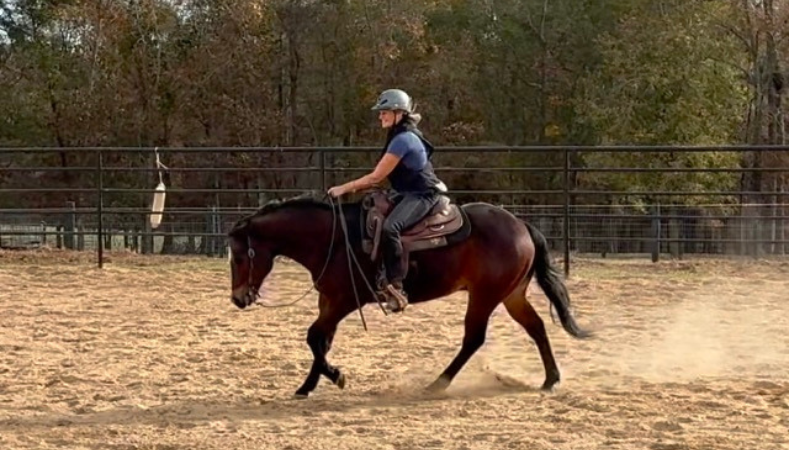
But step by tiny step, I kept riding, taking lessons, working on myself, learning about pressure and piecing together what worked for me. I captured those stories in Dancing the Tightrope as the list of horses grew and the pressure grew even more. Eventually, I started taking reining lessons, and this fall, I rode my 100th horse, a reining horse aptly named King. We did a every single move a reining horse does, including a full gallop and sliding stop.
My new project is to write a guidebook for Dancing the Tightrope. My vision is The Artist’s Way meets Good to Great. (I borrowed Jim Collins’s Flywheel metaphor in Dancing the Tightrope.)
In this week’s Coaching Digest, I’m sharing my first draft of the introduction to the book below. I have a simple question for you after you read this. What about this introduction makes you want to go through the book?
What makes you want to continue reading?
What makes you hesitate?
When writing a book like this, I’m constantly making choices to make it work for my readers and this kind of feedback is extremely helpful.
Dancing the Tightrope – A Guidebook
Draft Introduction
While navigating my corporate life, I pictured myself walking a tightrope—trying to stay balanced between how I wanted to show up and the pressure that pulled me off center. When centered, I could respond with clarity, presence, and “Power With.” But when the heat of pressure rose—sometimes a flicker, sometimes a full burn—I fell into the ditches on either side. On one side was Power Under: fear, looking for approval, hoping to prove myself. On the other was Power Over: forcing, grabbing control, using anger and intimidation to get my way. Both were automatic reactions shaped by survival mode and my patterns for dealing with pressure, and both knocked me out of balance. Both cost me my composure.
The tightrope became a useful metaphor because life is never solid ground. Pressure is a reality whether I like it or not.
Pressure is always moving us, challenging our balance. We under or overreact from our past conditioning unless we consciously choose to recalibrate our inner sensations to meet the moment. The goal isn’t perfection or staying perfectly centered; it’s learning to dance with the sway, and be ok with the physical sensations that tell us that “something is off.”
I call those sensations the Froth, like foam at the edge of the ocean, where water meets soil, or the bubbles in a carbonated drink that has been shaken up. A little of the new, a little of the old. Squishy. Uncomfortable. And a moment of choice.
My early visions of walking the tightrope were fraught with danger. Falling off seemed both imminent and permanent. Time and again after a tough meeting, I walked back to my office drenched in the cloak of failure, wondering why I held my tongue when I should have spoken up. Going “power under” felt, well, powerless. So next time I would grasp for power, speaking sharply, when I could have made the point without the dagger. Going “power over” also felt powerless.
Finding that space in the middle felt impossible. Something was always pulling to the left and to the right. Keep your eye on the goal - no wait, pay attention to the chaos happening around you. Say yes to opportunities, but not too much or you will lose focus. Say no to distractions, but not too much or you will lose opportunities.
With all the ways to be knocked off center, staying in balance truly felt impossible. There’s a huge assumption in that way of thinking, and it’s one of many assumptions we will challenge in this guidebook. Can you spot it? Before reading on, take a moment and check in with YOUR assumptions about balance.
What must happen in order for balance to occur? Write your answer here:
Whatever you wrote, there is nothing right or wrong, good or bad about it. However, your assumption does have consequences, because it drives your thoughts, feelings, and actions.
Now I will tell you my previous assumption: balance is a fixed point to be achieved.
How does that compare to your assumption?
When I changed my assumption about balance, a cascade of other assumptions came tumbling down. Slowly - very slowly - I began to recognize that pressure was not the problem. How I saw pressure - the assumptions I made about it - created the herky, jerky feeling of walking a scary tightrope where nothing felt safe and a fall into the abyss awaited my every move.
We won’t get rid of the pressure. We don’t want to get rid of pressure.
Pressure is the catalyst to burn off our old patterns so that we can unleash who we were born to be.
We also won’t get rid of the tightrope. Life is a balancing act. But let’s not walk it with herky, jerky moves.
Let’s dance it!
Dancing brings a sense of joy to the picture.
That’s why I use the metaphor of Dancing the Tightrope.
The primary objective of this guidebook is simple and profound: to raise your pressure threshold. In other words, it’s to help you help yourself to be better under pressure.
Because pressure is everywhere. You feel it in conversations, deadlines, relationships, unexpected moments, and the quiet places where your doubts whisper the loudest. And under pressure, most of us lose access to the very qualities we rely on when life is going well. Our clarity, compassion, creativity, courage—these slip through our fingers when the heat turns up.
Raising your pressure threshold means something powerful: you retain more of yourself when it matters most.
You stay on the rope longer. You sway less. And when you do fall, you recover faster, with less damage to your confidence, your relationships, or your sense of who you are.
That alone is worth the work. But there is more at stake.
One of the core principles behind this work is restoring balance and harmony—not as static end states, but as dynamic skills. Ask yourself:
- Where would I like more balance?
- Where would I like more harmony?
- Where does pressure knock me off center?
And then ask the deeper question: What is the cost of continuing to fall off the rope in the same old ways?
Take a moment to write your answers to these questions.
Because pressure has a way of shrinking our world. When pressure overwhelms us, our lives get smaller.
We play safe.
We hesitate.
We retreat.
We tighten.
We survive instead of live.
But when we raise our pressure threshold, something else becomes possible.
Pressure no longer collapses our world—it expands it.
We have more capacity, more choice, more presence, more access to our truth.
We don’t just exist.
We live.
This is what’s at stake:
Your aliveness under pressure. Your ability to stay with yourself in the moment of Froth. Your freedom to walk the rope—not cautiously, but with a dance in your step.
When you picture yourself on a tightrope, notice what happens in your body. Maybe you feel the sway. Maybe you feel the heat of pressure rise in your chest or jaw. Maybe you sense how easy it would be to fall into one ditch or the other. That reaction is important, because this guidebook isn’t about my tightrope. It’s about yours.
You have your own tightrope to walk—the narrow line between who you want to be and the patterns that pull you off center. Think of it as your “middle.” And just like me, you probably have two familiar ways you fall: a version of Power Under, where you shrink or smooth things over to stay safe, and a version of Power Over, where you tighten, push, or take control to keep the sway at bay. These aren’t flaws. They are protective strategies your nervous system learned long before you chose them.
This work isn’t about perfect balance or never falling. It’s about learning to recognize the moment pressure hits—the sway, the heat, the tightening—and using that moment as a choice point. You can do what you know to do, and that’s fine. It works at some level or you would not be doing it. OR, you can use the discomfort as a moment to build your mental fitness.
You’ll practice tools that help you stay with yourself when the stakes rise, tools that transform pressure from something to endure into something that builds capacity inside you.
As you move through this guidebook, you’ll begin to understand your own tightrope—the shape of your patterns, the conditions that knock you off, and the practices that help you come back to center. You’ll learn how the heat of pressure becomes usable energy, how your body becomes your teacher, and how falling off becomes information rather than failure.
Everything ahead is designed to help you make this metaphor real in your daily life. To help you respond instead of react. To help you build a different kind of relationship with pressure—one that expands your possibilities rather than narrows them.
So with this metaphor in hand and your own tightrope beneath your feet, let’s begin.
Thanks for reading.
Would you read this book?
If you’ve ever felt pressure shrink your world, I want to hear from you.